Why Every Dental Lab Needs an Aligner Thermoforming Machine Today!
The dental industry has witnessed a dramatic transformation over the last decade, propelled by advancements in digital technology, patient-centered care, and a surge in demand for convenient orthodontic treatments. Among these innovations, clear aligners have emerged as the preferred choice for patients and practitioners alike, offering a discreet, comfortable, and highly effective solution for teeth straightening. To meet this growing demand, dental labs worldwide are seeking efficient, precise, and scalable solutions to manufacture clear aligners—enter the aligner thermoforming machine.
For modern dental laboratories, investing in an aligner thermoforming machine is no longer just an option—it is rapidly becoming a necessity. From streamlining workflow and boosting productivity to ensuring consistent, high-quality output, these machines have redefined how aligners are fabricated. Consequently, forward-thinking labs are leveraging this technology not only to keep pace with the market but also to unlock new levels of profitability, reliability, and flexibility.

The Clear Aligner Revolution: Why Demand Is Booming
Clear aligners have rapidly evolved from a niche orthodontic service to a mainstream treatment option. Patients appreciate their near-invisibility, comfort, and the ability to remove them for eating or oral hygiene. Dentists and orthodontists, on the other hand, value the digital precision and predictable outcomes facilitated by clear aligner systems, as well as their ability to treat a wide spectrum of cases, from minor crowding to complex malocclusions.
This customer-centric transformation has disrupted the market, creating new expectations around:
- Speed: Patients want fast service and quick turnaround times for their aligners.
- Customization: Each treatment step is uniquely calibrated to a patient’s tooth movement, requiring a high degree of individualization.
- Quality: Fit, clarity, and comfort directly influence treatment success and patient satisfaction.
Dental labs have responded to this demand by embracing digital workflows—from intraoral scanning and 3D model design to rapid prototyping and production. However, many labs still face bottlenecks in the manufacturing phase, especially when relying on manual forming, outsourcing, or outdated equipment.
Challenges in Traditional Aligner Fabrication
Before the advent of the modern aligner thermoforming machine, dental labs used basic vacuum formers or manual press devices to shape thermoplastic sheets over dental models. While these techniques can be effective for low volumes or simple appliances like retainers and splints, they present several critical drawbacks when scaled to clear aligner manufacturing:
- Inconsistent Heating: Manual devices often struggle with even temperature distribution, leading to variable material shrinkage, uneven thickness, or surface defects.
- Variable Pressure: Hand-operated methods cannot reliably control forming pressure, resulting in ill-fitting aligners and frequent remakes.
- Slow Throughput: Manual processes are labor-intensive and time-consuming—limiting the number of aligners a lab can produce per day, especially when handling multi-stage treatments for multiple patients.
- Quality Control Issues: Without precise automation, ensuring each aligner meets exacting standards for clarity, fit, and durability is a perpetual challenge.
As a result, dental labs that rely solely on traditional fabrication are often at a disadvantage compared to competitors who have invested in advanced automation. This is where the aligner thermoforming machine truly stands out.
The Aligner Thermoforming Machine: The Backbone of Modern Dental Labs
What is an Aligner Thermoforming Machine?
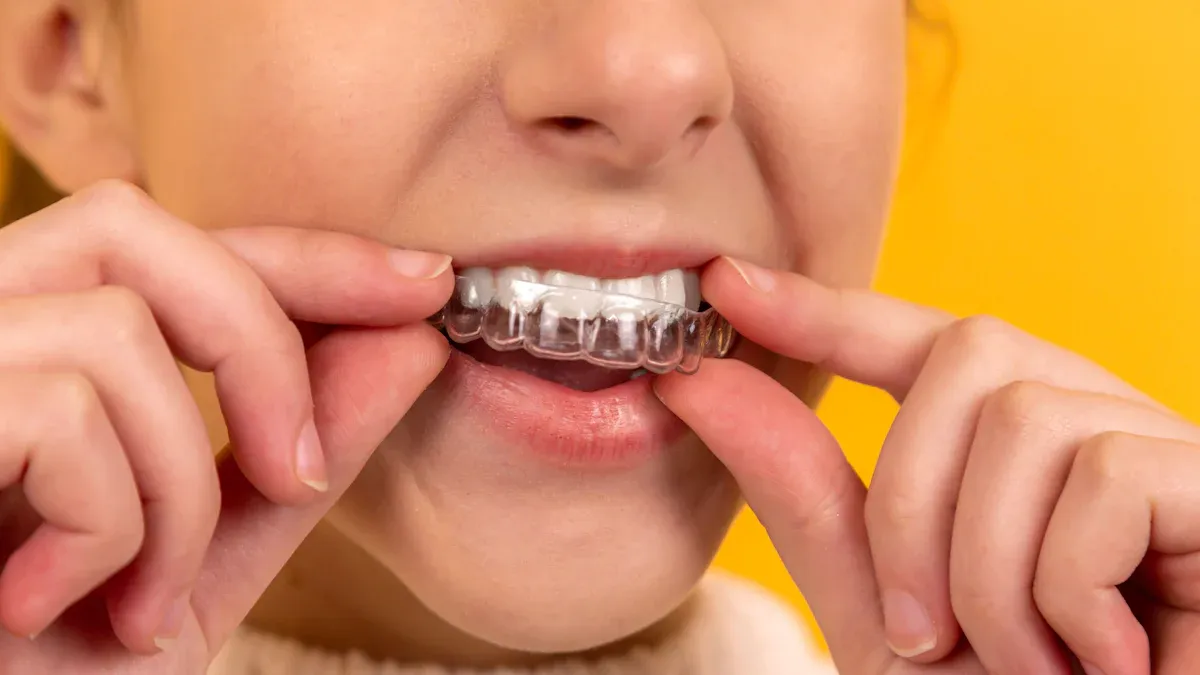
An aligner thermoforming machine is an advanced device purpose-built for the mass production of clear dental aligners. It consists of precision-controlled heating elements, a forming mechanism (using pressure, vacuum, or hybrid methods), programmable logic controls, and various safety and efficiency features. Modern versions seamlessly integrate with digital workflows, making them the gold standard for current and future-oriented labs.
Also Read: How a Dental Aligner Thermoforming Machine is Transforming Orthodontic Clinics!
Key Capabilities of an Aligner Thermoforming Machine
1. Uniform Heating
Delivers precise, even heat across the entire thermoplastic sheet, minimizing warping and guaranteeing consistent material flow.
2. Programmable Pressure/Vacuum
Accurately forms the heated sheet over the dental model, capturing fine details and ensuring a perfect fit for every aligner.
3. Rapid, Repeatable Cycles
Allows labs to manufacture dozens or even hundreds of aligners per day with minimal manual intervention.
4. Consistent Quality and Thickness
Each aligner comes out with reliable thickness and clarity, improving comfort, efficacy, and aesthetic appeal.
5. Digital Workflow Integration
Interfaces with laboratory management systems, 3D printers, and CAD/CAM software for streamlined, error-proof operation.
6. Versatile Material Compatibility
Supports a variety of medical-grade thermoplastics—PETG, PU, TPE, and more—for diverse patient needs and preferences.
The Competitive Advantage
Labs equipped with aligner thermoforming machines gain decisive competitive advantages:
- Meet or Exceed Rising Demand: Scale production efficiently, accept more cases, and serve more orthodontists/dentists.
- Shorten Turnaround: Move from digital model to finished aligner in hours, not days.
- Reduce Costs: Cut labor and wastage while maximizing material yields.
- Enhance Client Trust: Consistently deliver top-tier aligners, fostering loyalty and positive referrals.
Essential Features to Look For in an Aligner Thermoforming Machine
When evaluating aligner thermoforming machines for your lab, several features are paramount:
1. Precision Heating Technology
Even slight temperature inconsistencies can lead to material defects. Look for:
- Multi-zone heating elements for spatial accuracy.
- Fast response and recovery times.
- Closed-loop feedback sensors for real-time adjustment.
2. Consistent Forming Pressure
Choose machines that:
- Deliver both high-pressure and vacuum forming for optimal adaptation to various aligner geometries.
- Monitor and adjust forming pressure throughout the cycle.
- Support both rapid and deep draw processes for complex cases.
3. Digital Integration
- Touchscreen HMIs for recipe storage, diagnostics, and real-time process display.
- USB or WiFi connectivity to integrate with practice management and CAD/CAM solutions.
- Batch processing modes for high-throughput tasks.
4. Easy Changeovers and Maintenance
- Quick-release clamping systems for fast material changes.
- Accessible design for easy cleaning and maintenance.
- Automatic alerts and troubleshooting aids to minimize downtime.
5. Operator Safety
- Cool-touch exteriors and safety guards.
- Interlock mechanisms to prevent unintended starts or hand injuries.
- Thermal cutoffs and alarms.
6. Material Flexibility
- Compatible with leading brands of aligner materials.
- Adjustable for different thicknesses and sheet sizes.
At Shanghai Zhanshi Mechanical Equipment Co., Ltd., each aligner thermoforming machine is engineered with these priorities—helping labs operate with confidence, today and as demand continues to grow.

Real-World Workflow: How an Aligner Thermoforming Machine Transforms Lab Operations
Step-by-Step in a Modern Dental Lab
1. Digital Data Acquisition
- The lab receives digital scans or impressions from the clinic.
- A series of digital dental models is created, representing each sequential treatment step.
2. 3D Model Fabrication
- Models are printed using high-precision 3D printing technologies (e.g., SLA, DLP).
3. Aligner Thermoforming
- Each 3D-printed model is mounted in the aligner thermoforming machine.
- The operator selects or uploads the right program, loads the material, and initiates the cycle.
- In seconds, the heated thermoplastic forms tightly over the model, adopting its shape exactly.
4. Trimming and Polishing
- The aligner is removed, automatically or manually, and then trimmed to remove excess material.
- Edges are polished for patient comfort.
5. Quality Control
- Finished aligners are checked for clarity, thickness uniformity, and proper fit before being packaged for delivery.
This workflow is smooth, standardized, and can be operated by a small team, helping even medium-sized labs deliver enterprise-level results.
Why This Matters Now
Modern patients demand more from their orthodontic experience. Dentists and orthodontists are choosing lab partners who can keep them competitive—delivering clear aligners faster, at lower cost, and with total consistency.
For small and large dental labs alike, failing to invest in advanced aligner thermoforming machines means risking obsolescence in a rapidly evolving field. Early adopters, by contrast, find themselves winning new business, building reputations for reliability, and exploring lucrative custom applications (mouthguards, splints, retainers, and more) with the same equipment.
The aligner revolution is here, and with it comes tremendous opportunity for dental labs ready to embrace the latest in manufacturing technology. The aligner thermoforming machine is no longer an accessory—it is at the heart of every efficient, high-performing, and competitive dental lab. With precise heating, automated forming, seamless digital integration, and rapid cycles, your ability to produce clear aligners will never be the same.
Frequently Asked Questions (FAQ)
Q1: What materials are compatible with aligner thermoforming machines?
A: Most machines can process PETG, PU, TPE, PC, and other medical-grade transparent thermoplastics. It’s crucial to review your machine’s compatibility, as well as the manufacturer recommendations for optimal settings.
Q2: How many aligners can be produced in a day?
A: Production rates vary depending on the machine’s capacity, operator efficiency, and workflow integration. However, most mid- and high-end machines can produce 100 to 300 aligners per shift, and even more with batch automation.
Q3: Will it work with my existing 3D printer and digital workflow?
A: Yes. Leading aligner thermoforming machines are designed to be agnostic, supporting data from all major CAD/CAM and 3D printing systems.
Q4: What’s the expected lifecycle and maintenance of these machines?
A: With regular cleaning, calibration, and part replacement, a quality aligner thermoforming machine should last 5–10 years or more. Maintenance requirements are minimal but crucial for consistent output.
Q5: Can a single machine fabricate other dental appliances?
A: Absolutely. In addition to clear aligners, these machines can create sports mouthguards, whitening trays, retainers, and custom night guards—broadening your lab’s service portfolio.
Q6: How does the quality compare to outsourced aligner production?
A: In-house aligner thermoforming machines usually match or surpass the quality of large manufacturing centers—offering tighter turnaround times, local control, and direct oversight.
Q7: Is staff training required?
A: Yes—but most machines are designed for intuitive operation. Leading manufacturers, like Shanghai Zhanshi Mechanical Equipment Co., Ltd., offer comprehensive training and support resources.
Q8: Are automation and remote monitoring available?
A: Many contemporary machines offer IoT integration for remote monitoring, production tracking, and predictive maintenance.
Q9: What should I budget for an aligner thermoforming machine?
A: Prices range widely depending on features and capacity. Entry-level professional machines start around a few thousand dollars, while high-throughput models can run higher. However, ROI is swift given reduced outsourcing costs and increased case volume.
Q10: How do I choose the right machine for my lab?
A: Consider your current and expected case volume, digital workflow, space, desired level of automation, and the materials you plan to use. Consulting with experienced manufacturers is key to a smart investment.


Comments
Post a Comment